Contrary to popular belief you can’t see the Great Wall of China from Space. Even China’s own astronaut, Yang Liwei, said he couldn’t see it and you can imagine how hard he tried. According to NASA, even low orbit crafts, like ballistic missiles and Richard Branson, can’t see the thing.
In fact, due to all the air pollution, it seems that lately you can’t even see China from space.
You can see China in the news, however.
Pictures of polluted cities like Beijing, Jinchang and Linfen are a scary sight to behold. Or they would be, if you could actually see anything. I’m reminded of the hilarious coverage of the men’s downhill at the 2010 Winter Olympics in Vancouver on a foggy day when all you could see was a CGI stopwatch, the name of the skier and the time he had to beat. All of this was superimposed over an utterly white screen where you were told something ski-like was happening by an earnest sports commentator.
China’s situation is quite different from Vancouver’s, of course, because it’s a mustard-colour-out instead of a whiteout and it’s not hilarious. The media has been keen to remind us of the non-hilarious nature of the Chinese pollution story. Coverage has ranged from the horrified to the smug – rarely the comedic or the satirical.
The seriousness of the situation there can be underlined by the Chinese government giving the Chinese government a failing grade on environmental protection. Considering the Chinese government still hasn’t given itself a failing grade for the Cultural Revolution – a time when “having some Chinese” had a whole new meaning – this is a pretty remarkable forehead smack.
Of course, talk is cheap, and the Chinese government, under the bemused, side-long look of Western mass media, did a lot of talking. It wasn’t until March 2013 – three months after the smog became so thick the term ‘blind date’ became ubiquitous for any couple going out together – that the National People’s Congress announced that there was something stinky going on with the air quality. They also announced that they could predict danger-smog two days in advance. As visibility was quite low in the government buildings that day, however, the announcements may have been made to a tricycle.
Six months later, the Central Government unveiled their “Airborne Pollution Prevention and Control Action Plan”. Although, reports showed that, for the time being, it was less “action” and more “plan”. Nothing else happened until February of 2014 when, as Reuters reported, China sent “teams of investigators to parts of the country worst hit by air pollution as part of efforts to stop the heavy smog engulfing about 15 percent of the country.” Possibly this could be interpreted as action, but only in the same way a cow standing in warm water could be interpreted as stew.
After this we didn’t hear much about China and its smog. It’s not as if the smog had stopped, it’s more that everyone was waiting to see what the investigators came back with. If there were investigators at all. The Central Government could easily have been using the old beleaguered married man’s trick of saying he’ll “do the chores in a bit” to buy a few more minutes of scratching his belly in front of the television.
You’d think that the millions of Chinese people suffering from, what can only be described as months of industry-sanctioned tear-gassing would be the sum total of victims involved. You would be wrong. The people most hurt by China’s massive pollution problem were the Western journalists trying to cover an issue two years in the running.
Hyper self-conscious of running the merry-go-round of repetition, news sources often go apoplectic trying to find a new angle for the same old story. This kind of psychological strain is known to have sent many fine journalists into the reporters’ version of Abu Ghraib: writing copy for advertising agencies. Luckily, people all over the world chimed in with ideas on how to beat Chinese air pollution. Many of them, apparently, using the same play-book Wile E. Coyote used to try to beat the Road Runner.
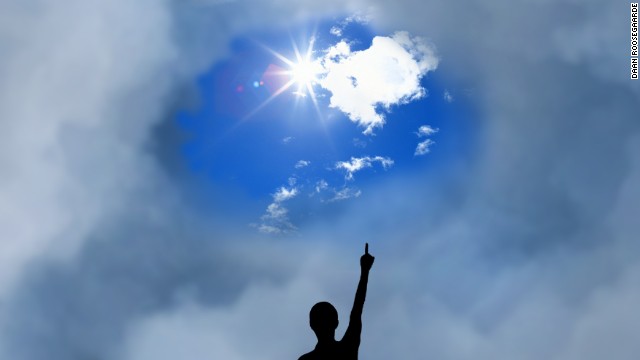
The International Business Times reported on a proposal to position “sprinklers on the roofs of tall buildings to spray water into the atmosphere to collect particulate matter, similar to how rain removes airborne dust.” Because the only thing that beats breathing it in, is drinking it down. CNN looked at “an electromagnetic field generated by copper coils [which] will pull airborne particles in the smog to the ground where they can be easily cleaned.” Aside from the field also drawing anybody nearby wearing jewellery to the ground, CNN weirdly topped the article with a photo of some guy flipping the bird at the sun (pictured above).
Other solutions included a giant vacuum cleaner, as made famous in the movie Space Balls and a bicycle which sucked in dirty air in the front and blew clean air out the back.
The Chinese government, not to be out-wackied on their own turf, shifted straight from first gear to fourth and proposed levelling mountains to allow the trapped smog out. Speaking of trapped smog, last month The South China Morning Post headlined “China to build ‘world’s largest’ smog chamber to solve pollution puzzle”. No updates this month on that bit of investment. One wonders if they ever did manage to find the additional smog to fill their chamber.
Also, frighteningly, the Government is seriously considering raising the ante on the building-sprinklers idea – by trying to make actual rain fall from the sky. The Washington Post, half way down their article, said, “Beijing’s vice mayor told subordinates his city was researching the method.” Farther down, the Post went a bit Twilight Zone – describing an already existing “rainmaking force” of which China has the largest. It is composed of “6,902 cloud-seeding artillery guns [and] 7,034 launchers for chemical-bearing rockets.”
Huh?
I may have been out of the journalism game for a couple of years, but not long enough to know, that’s your story right there, Washington Post: China has the means to mess with the weather and they have a lot of it. This isn’t just burying the lead, this is taking lead out back, shooting it, pissing on it, tying it to a concrete block and then dropping it into the Mariana Trench.
It’s hard to single the Post out for missing the story, though, a lot of publications did.
While much fun can be had with adaptation to the problem – like providing air-pollution insurance for people visiting China – the mitigation aspect is far more awkward.
The fact is, air pollution in China comes from the millions of factories in the country which are making stuff. Stuff for us. Stuff like iPhones and fridge magnets and table lamps and car mufflers and dog bowls and baby strollers and adidas and little corn-on-the-cob-shaped corn-on-the-cob pinions. You mitigate the problem – deal with it before it begins – by closing the factories, or making them go green. But then, while the greening happens you may not be able to buy as much stuff, for as cheap. And…well…that’s just not happening.
Meep meep.


 arindehoog